










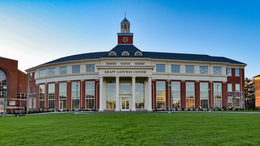
A Broader Approach to Health Sciences
At Lycoming College, new programs in biomedical sciences and exercise science pair rigorous scientific preparation with the perspective and personal attention of a liberal arts education.
High school students considering careers in medicine and health care know that a strong foundation in science matters, but they may not realize that the best preparation extends well beyond the laboratory. Future health professionals also need to think critically, communicate effectively, and understand the people they will ultimately serve.
At Lycoming College in Williamsport, Pa., that broader preparation is built into the experience. More than 200 years old, the school is one of the country’s oldest and consistently ranks among U.S. News & World Report’s Top 100 National Liberal Arts Colleges and Best Value Schools.
Drawing on its longstanding strengths in the liberal arts and sciences, Lycoming offers two new programs for students interested in health and human performance: biomedical sciences and exercise science.
“Lycoming has stood the test of time without ever standing still, building a deep science tradition with a 10:1 student-to-faculty ratio where students are known, mentored and challenged. The new exercise science and biomedical sciences majors carry that mission forward, connecting classic scientific rigor to one of the fastest-growing fields in health and human performance,” says David Andrew, Ph.D., assistant professor of biology and chair of the department.
Both new programs give students access to hands-on labs and professional experiences, as well as teaching the hard scientific skills and soft skills that graduate and medical schools, as well as employers, look for.
“As an institution that stays at the forefront of academic innovation, Lycoming recently took a serious look at where the college’s strengths in the sciences intersect with student demand. Exercise science and biomedical sciences came out on top,” says Andrew.
The exercise science program fulfills student interest in the study of human health and performance, combining exercise, physiology, anatomy, biomechanics, nutrition and psychology to teach students to understand human movement, wellness and physical activity.
The biomedical sciences program puts students on a rigorous, interdisciplinary path that prepares them for further education and careers in medicine, health care and biomedical research. It allows coursework to be tailored to a student’s specific goals, whether that be medical school, physical therapy, pharmacy, veterinary medicine, nursing or research.
Each program lets students pursue either a B.A. or B.S., allowing them to tailor their coursework and college path to their aspirations.
“The bigger advantage is the breadth. Health profession schools are explicitly looking for applicants who can think critically, write well and understand people, not just the sciences, and a liberal arts curriculum builds exactly that alongside the hard sciences. A student majoring in biomedical sciences or exercise science is taking courses in ethics, psychology, sociology, even anthropology, alongside biology, chemistry and physics, which makes for a more well-rounded, more competitive applicant, and frankly a better future clinician,” says Andrew.
Getting a degree in the sciences from a liberal arts institution has some distinct advantages, specifically for those looking to go into health care and human performance professions. Unlike undergraduate programs at schools that specialize in STEM, students in the science programs at Lycoming are not competing with hundreds of others for a lab spot or a letter of recommendation from faculty.
As a result, students start doing research and clinical-adjacent work early in their college careers. When the time comes for faculty to write committee letters for internships or postgraduate education programs, they have gotten to know each student well.
Both programs feed into Lycoming’s Lyco White Coat program, pairing first-year pre-health students with alumni in medical and health care roles. Students are able to receive not only the individualized faculty advising available to all students but also guidance for every step of their education at Lycoming, including medical school admission, MCAT preparation, assistance in securing shadowing opportunities and help with the personal statements and interviews that come along with the medical school admission process.
“Students in either major who have their eye on medical or health-professional school aren’t figuring that out alone, they’ve got a mentor and an advising structure walking with them from day one. We also have expanded our general pre-health advising to include a stronger focus on mentoring all students interested in health-related professions in addition to our Lyco White Coat program,” says Andrew.
The education at Lycoming is also accessible, with 85% of students receiving financial aid.
“The outcomes speak for themselves: 95% of the Class of 2025 entered graduate school or found employment within a year of graduating,” says Andrew.
Besides stellar academics, Lycoming has more than 60 clubs, 20 NCAA Division III teams and an Outdoor Leadership program. Located in Williamsport, Lycoming is close to plenty of recreation, dining and culture, while the city itself is within a few hours of Philadelphia, New York City and Washington, D.C.
“You’ll build real experience here. Williamsport’s health care systems, businesses and organizations give you direct access to internships, practicums and hands-on opportunities that strengthen both your resume and your graduate school applications. You get the tight-knit campus feel without feeling far from everything else,” says Andrew.
Lycoming College
Williamsport, Pa.
(570) 321-4026