










Road Rules
New statewide laws aim to make e-bikes safer for riders and the public, but those in the bicycle industry feel the regulations may go too far.
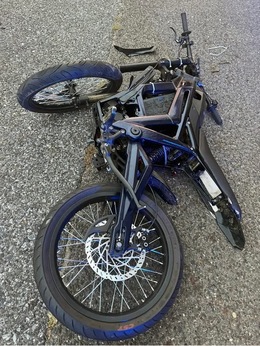
For Kelly Nuzzo, the call that every parent dreads came on a crisp Monday afternoon last November, a week and a half before Thanksgiving. The Washington Township Police reached out to inform her that her son Greg, 15 at the time, had been hurt in an accident involving an e-bike that she had no idea he was even riding.
Fortunately, she learned quickly that his injuries, while serious, were not life threatening. She accompanied him to Jefferson Hospital and later to The Trauma Center at Cooper University Hospital, where he was treated for two broken wrists and a fractured knee and had to stay overnight until that Friday.
Greg had to do homebound instruction via Zoom for the next month-plus and was not able to return to school until January. Even worse, his family had to help him with the simplest of tasks, because of the enduring discomfort and the fact that he couldn’t lift anything heavier than his phone.
“He couldn’t do anything,” Nuzzo recalls. “For the first couple of weeks we had to feed him because he was in so much pain. It was really bad. It was hard on him and all of us, but he was lucky. It could have been worse.”
Other New Jersey kids have tragically found that out, with two teens dying in separate accidents in June, one of them in Burlington County. E-bikes—a general term covering everything from pedal-assist electric bicycles to e-motos that resemble mopeds or motorcycles and are much more powerful and faster—have become increasingly popular in recent years for people of all ages, but concerns about their safety, especially for children, continue to be raised.
Nuzzo’s son had been riding a friend’s e-moto without her knowledge for about a month prior to his accident, which happened when he was blinded by the sun and crashed into a parked car on the shoulder of Ganttown Road, a busy area that connects with the Black Horse Pike. He has shown no interest in riding an e-bike of any kind ever since, and his mom would advise any parent against getting one for their child.
“I would tell them not to buy one, 100%,” Nuzzo says. “I wouldn’t even recommend buying a regular e-bike. Kids get on these bikes and they think they have the right of way and that the cars have to watch them. The problem is that kids think they’ve invincible and that nothing bad is going to happen.”
As a means of protecting e-bike riders and the general public, new state laws went into effect July 19. To ride one, operators must now be at least 15 years old and have an e-bike license or a valid driver’s license. All e-bikes must be registered with the New Jersey Motor Vehicle Commission, and the motorized bikes, or e-motos, must also have insurance coverage.
Washington Township Police Chief Pat Gurcsik has issued an e-bike enforcement summary to all of his officers outlining the different models of e-bikes and the necessary roadside documents.
“It was overdue,” he says of the new law. “Our primary concern is public safety. E-bikes and electric motorcycles are becoming increasingly popular, especially among young people. We’re not discouraging e-bike use, but we realize—and I’m sure the Legislature realized—that these e-bikes are much faster and more powerful than they were just a few years ago. So they responded to the increase in crashes and serious injuries by requiring greater accountability from the rider.”
Gurcsik adds that his department is not out to punish e-bike riders.
“We’re more concerned with educating the public about the requirements than enforcement, but we do have enforcement options … under the new law,” he says. “There’s a $50 fine and motorcycles or e-bikes can be towed. At this point, there’s still a learning curve for everybody.
“We’re not out there looking to stop every kid on an e-bike. Our primary focus early on is unsafe behavior that puts riders or the public at risk. We’re looking for reckless operation, excessive speed, kids riding without helmets, riding through traffic, or two kids on an e-scooter. We would definitely pull that over and talk to the parents the first time.”
Elsewhere in South Jersey, the Moorestown Township Council has supplemented the state laws with an ordinance that went into effect on the same day. It applies to low-speed e-bikes, motorized bikes and mopeds, electric motorized bikes, low-speed electric scooters, electric dirt bikes, and similar motor-assisted mobility devices.
The ordinance generally prohibits the use of these devices on township sidewalks, with limited exceptions; prohibits their use on township trails unless specifically permitted by posted signage, with a maximum speed of 15 miles per hour; and prohibits them on school grounds except on designated roadways, bike-rack approaches or drop-off lanes, where they may not exceed 10 miles per hour. Riders may use sidewalks and bike paths adjacent to county roads at speeds of 10 miles per hour or less.
Safety requirements include yielding to pedestrians, riding in a safe manner, providing an audible warning before passing pedestrians and not using hand-held phones while riding.
Moorestown Mayor Quinton Law explains that he and the council started having serious conversations about the ordinance last fall, after being approached by a resident who was injured while walking when two kids crashed into her on e-bikes.
“My No. 1 goal here is public safety. There have been injuries here in town, and I saw those as preventable,” he says. “I thought the resident was right when she came to us and challenged the council to do something, because these bikes have gotten out of control. I don’t want to be the person telling residents in our community that they can’t have fun; this isn’t about telling folks they can’t have fun. I do believe you can enjoy e-bikes safely, but we need to follow the rules. If we can follow the rules, we can ensure that everyone is enjoying Moorestown safely, regardless if you’re on an e-bike or not.”
Similar to Washington Township, Moorestown is stressing education in the early days of the state law and its ordinance, as it has instituted a 90-day grace period. Those who are stopped for violations will be given warnings and informed of the new rules, but after the first three months, fines or other penalties could be handed out.
Law admits there was some initial pushback on the Moorestown ordinance, particularly from younger residents, and the state laws have also received criticism, namely from those in the bicycle industry. Patty Woodworth, the owner of Action Wheels in Wenonah, sells different varieties of e-bikes in her shop, and believes the pedal-assist, low-speed bikes are beneficial to traditional cyclists who may be facing physical limitations as they get older but still want to do a hobby they love.
“E-bikes are awesome,” she says. “They’re getting people to ride bikes who had just given it up. They’re bringing people back, not just to the sport but to some level of health. If you’re just throttling the bike around [on an e-moto], you’re more sightseeing than exercising. But with a pedal-assist, it allows them to get in at a level their body can tolerate, and then they just get better at it. They get stronger, they ride further, and they actually become a cyclist when they didn’t expect it to happen.”
Woodworth’s issue with the state laws, and with public perception about e-bike safety, is that pedal-assist, low-speed e-bikes are being categorized with e-motos, which are much different.
“I think the entire industry feels like our government overstepped here in New Jersey, and that probably nobody rode [an e-bike] before they could actually realize what they were making laws about,” she says. “The e-motorcycles are being grouped together with the stuff that is completely safe and that people are buying to get to work or to get some exercise.
“There are people who come in here in their 60s, and they’re using them to get around, they’re using them to go on vacation and go see things,” she continues. “They’re not reckless, they’re not running into people’s cars and they’re not killing small children. It just doesn’t make any sense why this law threw everyone into the same basket when the big problem is throttle motorcycles.”
Cherry Hill resident Scott Downie is the president of Team Evesham Cycling Club, which was founded 15 years ago and now has several hundred members. The club holds group rides of different sizes and paces almost every day of the week, and is also heavily involved in charity events, especially in support of the American Cancer Society.
About two years ago, Team Evesham decided to welcome riders of e-bikes into its club, with several rules in place. Chief among them was that the e-bike had to be pedal-assist and not a throttle e-moto.
“At the time we had some riders who had been riding for a while but were getting older, or some people who had come under some physical challenges but still loved riding,” Downie says. “They were looking into e-bikes because it was going to allow them to keep riding with the group and keep doing an activity they enjoyed doing. So we wanted to accommodate that.”
Downie adds that the e-bike riders have fit in seamlessly with the club and there have been no problems with the traditional cyclists. He has never tried one himself, but would consider it in the future if he were physically unable to continue cycling just so he can continue his passion, which he loves for both the health benefits and the socialization aspect with friends.
Like Woodworth, Downie feels a distinction has to be made between pedal-assist bikes and e-motos.
“I think some opinions are forming, unfairly perhaps, that e-bikes are not safe and that people are using them in the wrong way,” he says. “Just like anything else, there are probably some people who are doing that, but there are also people who are using them exactly the way they should be used and are riding them consistently with the requirements.
“It will be interesting to see how this develops. I hope that people who are picking up e-bikes for the first time are also learning the right way to do things: helmets, safety, follow the rules of the road. … There’s nothing inherently unsafe about any of them if you ride them right. Safety has more to do with the rider than the vehicle. I think in some people’s perception, they’re all being lumped together, but there’s no reason they all can’t be ridden safely.”
Safety is the primary concern for officials like Law, who led the effort for Moorestown to become part of the national organization Vision Zero Network and to adopt a resolution to reduce the town’s traffic deaths and injuries to zero through improved infrastructure and systems that can create safer roads. He has been approached by several mayors from across the state looking to do the same in their communities, starting with e-bike ordinances.
But he also recognizes the resistance by some groups and believes there is wiggle room in any rules that are established.
“I’m the mayor of Moorestown; I’m not in the state legislature,” he says. “I certainly don’t think that the regulations created by the state are perfect, but I’m glad that the state did something and I hope that they listen to advocates and cyclists and continue to amend the law so it can become something that is best for all parties. Here locally, I’m making sure that we ride safely. There was some pushback initially, but most people understand that they have to wear a helmet, there are speed limits and you can’t speed down Main Street on the sidewalk. And most people appreciate that.”
Gurcsik stresses that parents especially need to consider the responsibility that comes with an e-bike, particularly the high-speed e-motos.
“Many purchase these devices with good intentions, especially around Christmastime,” he says. “They’re convenient, they’re fun, they allow the kids to have some independence. But we’re encouraging every parent on social media to understand exactly what they’re buying. These e-bikes travel at speeds comparable to the old mopeds and motorcycles and they should be viewed as serious vehicles, not as a bicycle or a toy.”
Nuzzo hopes her son has learned that lesson. He is back to normal now, with no ill effects from the accident, and in fact was able to return to action with the Washington Township golf team this past spring.
She just prays that no other parent has to endure what she went through, or worse.
“Every time I see kids riding those things, I just want to wring their necks. I cringe every time,” she says. “My son is now driving with his permit, and he can see how scary it is as a driver when these kids are on the side of the road. Hopefully the requirements will help and it will get better. I don’t want to hear about any more kids dying."
Click here to subscribe to the free digital editions of South Jersey Magazine
To read the digital edition of South Jersey Magazine, click here.
Published and copyrighted in South Jersey Magazine, Volume 23, Issue 4 (July 2026)
Published and copyrighted in South Jersey Magazine, Volume 23, Issue 4 (July 2026)
For more info on South Jersey Magazine, click here.
To subscribe to South Jersey Magazine, click here.
To advertise in South Jersey Magazine, click here.
To subscribe to South Jersey Magazine, click here.
To advertise in South Jersey Magazine, click here.