








A Special Connection
At Ahavah Farm, interaction with horses helps students grow socially, emotionally and physically.
In a fast paced world with AI seemingly at every turn, Sarah Rabinowitz Mognoni believes that natural horsemanship is the antithesis of the artificial takeover.
As prey animals, horses live in the moment, and good horsemanship relies on doing the same.
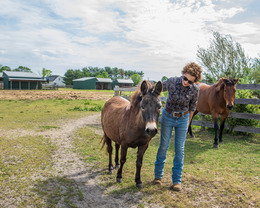
“You simply have to work through the development of the relationship with the horse, and that's primarily physical,” says Mognoni, owner of Ahavah Farm and Colorful Living Studio where students learn physical, social and emotional skills through interacting with and forming an understanding of their many horses.
She explains that the physical contact needed between human and horse and the way handlers have to work to develop the relationship cannot be replicated or faked.
Only about 15% of this education at Ahavah involves riding. The rest is building that relationship, learning to communicate with the animals in their own language and observing the herd.
“What happens during the course of this training is that students actually find out a lot about themselves, in addition to helping the horses learn,” says Mognoni.
The herd consists of 17 horses, several of which have physical and emotional challenges. While Mognoni admits they are not the easiest ones to handle, even those with no experience are encouraged to get involved and find a comfort level interacting with the animals.
Teaching communication with horses involves a structured approach to building a joint language between students and the animal, giving them steps along the way, like asking the horse’s permission or to move in a certain direction.
“There’s a whole series of tasks that we go through to improve overall communication and then also make riding much, much safer,” Mognoni says.
Ahavah is an approved vendor for the New Jersey Division of Disabilities, meaning that a continuous group of students have chosen the farm as their preferred place of instruction for children with disabilities.
Equine therapy, another offering at Ahavah, helps those with autism, PTSD, anxiety, Down syndrome and a number of other disabilities, as the nonverbal communication necessary with horses is comforting to those who may communicate differently.
“There’s almost an instantaneous bond that develops. And the other element to that relationship building is that those students tend to be completely nonaggressive, so they don’t come to the farm with a preset agenda. ... Horses feel instantly comfortable,” says Mognoni.
Just sharing space with the animals provides a release of anxiety for the students, and the horses automatically come to them without being led.
This special connection that is possible between humans and animals is one of the reasons Ahavah Farm supports H.R.1661, or the SAFE Act, introduced in Congress last year. This bill would prohibit the slaughter of horses for human consumption in the U.S. as well as their transport abroad for the same purpose.
Besides the horses, the farm also features four enclosed pollinator gardens in the middle of the pasture which are home to various species of native plants and act as a shelter to various animals. The farm is currently looking for interns to learn about native plants, and help to maintain and design the various elements of the gardens.
In addition to these programs, a number of projects have recently been launched to spread Ahavah’s reach further, most notably their venture into film.
Shortly after Mognoni created a YouTube channel for the farm, she looked for a way to tell stories that have not been heard before, specifically focusing on the backgrounds of different animals.
One short film, Lucky Gideon, tells the story of a horse during the Civil War who accompanies a grieving widow into battle for the Union Army following her son’s enlistment. The story honors the 1.1 million horses and mules that were killed throughout the course of the war and the film earned an honorable mention at the Equus International Film Festival.
Mognoni is now working on another film, an animated murder mystery titled Who Killed Detective O’Leary. It’s a satirical story where the herd solves the killing of the titular investigator.
In addition to the therapy services and attention-grabbing films, Mognoni is further connecting with the South Jersey community through the Colorful Living Studio, which is always open for fine arts instruction. What’s more, folks can now book the herd for their wedding portraits or other special celebratory occasions.
“The horses love it. They absolutely love it, mostly because they’re not required to do very much except just socialize, which they thoroughly enjoy,” says Mognoni.
Mognoni and everyone else at the farm plan to continue building the unique relationship between horses and humans.
“It is not possible to fake a relationship with a horse, because horses can’t do anything but tell the truth,” says Mognoni.
Ahavah Farm and Colorful Living Studio
Waterford Works
(856) 340-3784